CIWF launches stakeholder action plan to accelerate farrowing transition
14th Apr 2025 / By Alistair Driver
Compassion in World Farming (CIWF) has launched a Multi-Stakeholder Action Plan to accelerate the adoption of alternative farrowing systems in the UK.
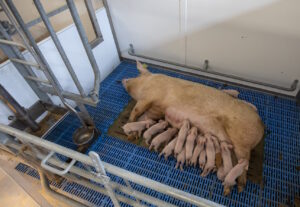
The plan identifies three key barriers to change -economic challenges, knowledge gaps, and stakeholder alignment – and provides a clear set of actions needed to overcome them. It also underscores the importance of collaboration across the supply chain to drive meaningful and lasting change.
CIWF has been campaigning for a ban on farrowing crates, which were introduced in the 1960s, for a long time.
The NPA, which has put forward a plan for a long-term voluntary transition to flexible farrowing systems, has described CIWF’s move to involve wider interests to address the barriers as a ‘significant step forward’.
Four companies – Greggs, Marks and Spencer, The Compleat Food Group and Waitrose – have already confirmed their support for a collaborative approach to scaling up alternative farrowing systems as laid out in the Action Plan.
“Their support sets an example for the wider industry, and we are looking for others to join. Achieving industry-wide change will require a shared vision and collective action to ensure a successful and sustainable transition,” CIWF said.
CIWF said mounting scientific evidence shows that ‘restrictive’ farrowing crate systems come at a ‘significant cost to the welfare of both the sow and her piglets’ and are widely seen as ‘outdated and incompatible with evolving animal welfare standards’.
But it said well-designed pen systems allow the sow greater freedom of movement while still providing protection for piglets.
There is a diverse range of indoor alternative farrowing systems already in commercial use and investing in well-designed, spacious systems that will deliver the expected welfare gains and stand the test of time is paramount for success, it said.
It said the shift to higher-welfare alternative systems is no longer a question of ‘if’, but ‘when’.
“The transition is inevitable, and the key to making it a reality lies in the collective action from all stakeholders, from farmers and policymakers to retailers and consumers, to invest in, support and implement practical, welfare-friendly farrowing systems that balance sow and piglet welfare, farm viability and consumer expectations,” it said.
The Action Plan is aimed at accelerating the adoption of alternative farrowing systems in the UK, identifying the three key barriers to changean d seeking solutions to them:
Collaboration across the supply chain to drive meaningful and lasting change is vital.
The UK pig industry is already making positive voluntary steps with a consensus view of not installing new farrowing crates.
The Building Suppliers Forum, a group of building and equipment suppliers, comprising the leading pig building specialists in Britain, is actively reinforcing this consensus by refraining from installing new crated systems and advising producers on alternative pen designs. The NPA has been leading on this area by developing a transition plan for some time.
In a joint statement, Tim Miller, ARM Buildings livestock environment specialist, and NPA chief executive Lizzie Wilson said: “As the leading suppliers of pig housing in Britain, supported by the representative trade association for commercial pig farmers, we recognise that the future of pig farming lies in higher welfare farrowing systems.
“The industry’s consensus of ‘No New Conventional Farrowing Crates’ is a significant step forward, and we are committed to supporting producers by providing innovative, practical, and welfare-friendly alternatives.
“By working together across the supply chain, we can ensure that the transition to well-designed alternative systems is both achievable and sustainable for farmers, while meeting the expectations of consumers and regulators alike.”
With one of the greatest challenges in delivering the transition being securing the necessary funding, the Action Plan emphasises the importance of a willingness to share the added costs, public commitments and secure contracts to create a market for higher welfare products.
This summer, CIWF’s Roundtable on Alternative Farrowing will focus on ‘Funding the Transition: Next Steps’, exploring how to ensure market support is provided for products from alternative farrowing systems.
It said it will be working to secure wider industry support to demonstrate the need for collective action and to give confidence to others to make the same step.
Over the next year, CIWF will work with companies to release statements of commitment to alternative farrowing, while ‘celebrating those who are already making significant progress toward this important goal’.
Dr Tracey Jones, CIWF’s global director of food business, said: “Transitioning away from farrowing crates is a critical step toward improving animal welfare in the UK pig industry.
“Achieving this requires collective action across the entire supply chain, starting with company commitments and a willingness of industry to change.”
In 2021 the European Commission made a clear commitment to introduce a legislative proposal to ban the use of cages for farmed animals within the EU. In February 2025, this commitment was reaffirmed, with the Commission looking to table proposals for an EU wide cage ban by species and sector in 2026.
In the UK, while farrowing crates are still legally permitted, the industry’s voluntary transition towards higher welfare systems deserves recognition as a major step forward, CIWF said.