From flexible farrowing to vaccine shortages – PIG discusses hot industry topics
11th Dec 2024 / By Alistair Driver
The NPA’s latest Pig Industry Group (PIG) meeting covered a wide range of topics of real significance to the pig sector, highlighting the breadth of the association’s work.
More than 20 people from all parts of the industry, including producers and the allied sectors, came together online on Tuesday for updates and discussion to set out the NPA’s position and agree action points across various areas.
Just some of the highlights included:
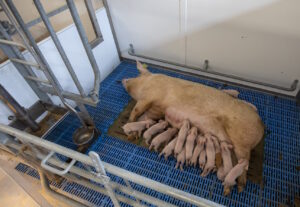
NPA senior policy adviser Katie Jarvis set out the NPA’s position on flexible farrowing, as recently summarised here, and the results of a member survey on a transition.
With the government expected to start pushing forward on this at some point, PIG was strongly supportive of the NPA’s approach for a voluntary transition over a 20-year period.
The biggest point of discussion was over the footprint of the new pens, with some producers keen for clarity on this, so they can plan for the future and start to invest. The NPA has proposed a minimum footprint of 5.5sq.m, but PIG accepted that others will be pushing for a larger footprint.
“We have proposed what we believe will deliver better welfare for the sow, while being manageable for the producer,” Katie said.
With the Building Suppliers Forum estimating a cost of £3,500-£5,000 per sow place to refurbish an existing building and £5,000-£8,000 for a new building – before planning and other associated costs – PIG highlighted the need for funding from government and the supply chain for the transition. In this context, there was concern that Defra’s freeze on some grants might affect support in this area.
Chief executive Lizzie Wilson updated PIG on the NPA’s work with Defra on new legislation governing contractual practice in the pig sector.
Defra is looking to press ahead with this legislation, aimed at bringing about a fairer pig supply chain, next year, after it was delayed by the General Election.
Again, PIG was supportive of the general approach, with much of the discussion focusing on whether the legislation could provide meaningful protection for producers when contracts are being breached, while, at the same time, ensuring producers are not unfairly penalised when they can’t fulfil their requirements.
There is going to be flexibility in the legislation, and it was stressed that the key will be the detail of the contracts that are agreed between buyer and seller. NPA chairman Rob Mutimer pointed out that one of the big differences is that an ombudsman will be in place to oversee any contractual disputes, under the new measures.
There was, inevitably, a great deal of concern among PIG in response to an update from Lizzie on the Farming Rules for Water, with Defra carrying out a ‘fast-track’ review that includes a review of the current statutory guidance on the regulation. The guidance currently permits autumn spreading without sanction from the Environment Agency. You can read more HERE.
She explained how various farming organisations had come together and ‘drawn a line in the sand’. “We have told Defra that the statutory guidance must be retained because we just can’t comply with the legislation without it. It would be completely unfeasible,” she said.
Andy Hall, from AM Warkup, pointed out that most farms do not have the 12-month slurry storage that would be required if autumn spreading was effectively banned.
Senior policy adviser Tom Haynes delivered an update on the situation with illegal meat imports, particularly through the Port of Dover.
He said the big change of late was that criminals were now targeting the commercial route to take advantage of flaws in the new Border Target Operating Model (BTOM, including the automatic clearance mechanism designed to prevent a build-up of traffic at Sevington, the inland border control post. He said this route was now dwarfing volumes coming through in personal imports and small vehicles through Dover.
He stressed, however, that there was growing awareness of the risk illegal meat imports pose among MPs, including the EFRA Committee, which is set to make it one of its prime areas of inquiry in 2025, and the new All Party Parliamentary Group (APPG) on Food Security, thanks in part to the NPA’s engagement on the issue.
He said there were ‘mixed signals’ coming through on whether Defra has agreed to a funding settlement that will enable Dover Port Health Authority to continue its crucial work in intercepting illegal meat imports.
Vet Gemma Thwaites said it was important to stress the human health risks associated with illegal meat imports too.
There was a big discussion on pig health, with vets and producers highlighting, in particular, the recent spate of swine dysentery cases, alongside more evidence of flu in some areas.
 Some producers joined Gemma, PIG’s veterinary representative, in expressing concern over the state of lorry washing facilities and practice at abattoirs – and highlighted the need for greater awareness of the need to take it seriously. The NPA is looking at reviving the #MuckFreeTruck campaign to remind everyone of their responsibilities.
The role of contractors and others who move from farm to farm was also highlighted, alongside the need for producers to be rigid in how they handle visitors and where visitors and staff are and aren’t permitted to drive and walk. The disease is very easily spread via vehicles, people and equipment.
Gemma noted that in many cases recently, the strains were not the typical virulent ones, with symptoms that are not necessarily obvious. As a result, the disease was sometimes taking a long time to be suspected and confirmed, and only then, sometimes as an afterthought after other issues had been ruled out.
Michael Putt, the PVS representative, noted a disparity between the number of official swine dysentery confirmations by APHA and the number of cases being reported on the Significant Diseases Charter, a Red Tractor requirement. He said there could be good reasons for this but stressed the need for all producer and vets to report cases, so that others within the industry are fully aware of the disease picture.
Gemma also highlighted the serious issue of the shortages of some vaccines and medicines within the UK pig sector. She suggested the situation was not helped by the UK pig sector sometimes no longer being seen as a ‘priority’ since the UK’s exit from the EU.
Members of PIG agreed to issue a joint statement highlighting the need to ensure the UK is properly stocked with the necessary pig health products to the relevant companies and administrations.
Also discussed at PIG: