Government will be complicit in major disease outbreak if they don’t address border failings, Lizzie tells MPs
4th Mar 2025 / By Alistair Driver
The government will be complicit in a damaging future disease outbreak, if it does not address the gaping holes in our border controls, NPA chief executive Lizzie Wilson told MPs today.
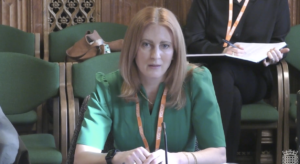 Lizzie appeared in front of the Environment, Food and Rural Affairs (EFRA) Committee this morning, alongside the British Poultry Council’s Richard Griffiths, AHDB’s lead veterinary science expert, Sarah Tomlinson and the Farming Community Network’s Judith McCann, as part of its inquiry into the government’s preparedness for animal disease outbreaks.
She highlighted the industry’s concerns, raised at a recent EFRA hearing, over news that funding for the Dover Port Health Authority to allow it to continue its vital work in seizing illegal meat imports will cease in April, unless Defra rapidly agrees to a new funding settlement with DPHA. Lizzie revealed that more than 200 tonnes of illegal meat has now been seized at Dover since September 2022, with volumes increasing markedly over the first two months of the year.
She also highlighted the current flaws in the Border Target Operating Model for commercial import checks and the recent revelations that products from Germany continued to enter the UK for a around a week after the ban FMD was implemented in January.
“We know that 90% of illegally imported products of animal origin are coming in via Dover Port and we know it’s coming in via the tourist routes, via illegally imported pigmeat in vans and coaches, etc.
“But we also know that it’s coming in via the commercial lanes because the BTOM just simply isn’t fit for purpose.
“We believe that more resource should be channelled to Dover. We still haven’t got any sort of funding agreement in place and we have literally got weeks before they will have to stop all of those inspections and checks.”
Lizzie pointed out that, while Border Force carried out important work at the port, it is DPHA that proactively carries out the meat siezures and is primarily responsible for the work.
“We also know that down the west coast of the country, there are no controls and no checks or monitoring whatsoever, so it’s essentially an open door for product to flow into the country,” she said, adding that the current personal import policy was confusing for tourists and very difficult to implement and enforce.
“We have safeguarding measures in place for FMD at the moment, but they are entirely pointless if there isn’t the resource dedicated to implement and enforce them. Otherwise, it’s simply lip-service and we know that, from January 10, when FMD was announced in Germany, the digital auto clearance system was still operational for products coming from Germany until at least the January 18 and it’s still active now.
“There’s no mechanism to identify those lorries that have self-declared themselves as low risk and, therefore, have auto-cleared, so they don’t have to be inspected.”
She said the government’s approach to border controls was ‘just isn’t good enough’ and called for more engagement from Defra with the different port health authorities and local authorities who are desperately trying to stop this product coming into the country.
“If we do end up with another notifiable disease, ASF is predicted to cost us between £10m and £100m and FMD potentially £14.7 billion in today’s money, and if that happens, government will be complicit, if they’ve not actually stopped the meat that they are entirely aware of is coming into this country.”
Lizzie said African swine fever was the pig sector’s biggest concern and pointed out that it is currently ‘very prevalent’ across Europe and has been making its way steadily westward for a number of years.
She pointed out that the Animal and Plant Health Agency (APHA) currently designates the risk of the human-mediated spread of ASF as ‘high’, and highlighted how the virus jumped 400 kilometres across the Baltic Sea from Poland to Sweden in September 2023.
“So, the fact that we’re an island surrounded by sea doesn’t make us any less at risk from such a notifiable disease,” she said.
She added that for the wider livestock sector, ASF was ‘the lesser of two evils’, as the greater concern was foot-and-mouth disease, which she said would be ‘catastrophic for the entire cloven-hooved livestock sector’.
She said the pig sector could be ‘irrevocably damaged’ from an ASF or FMD outbreak, which would result in the loss of export markets, worth about £600 million per annum, and shut down parts of the country, alongside potential widespread culling of infected pig herds.
“When your business has been through so much, mentally, financially and physically, I’m not sure many would be willing or able to re-stock afterwards,” she said.
In terms of asks for government, she called for:
Responding to the revelation that products continued to enter the UK after the FMD was in place, a Defra spokesperson said: “The government will do whatever it takes to protect our nation’s farmers from the risk posed by foot and mouth disease. That is why restrictions were immediately brought in on animal products from Germany to prevent an outbreak.
“We ensured that auto-clearance facilities were superseded by robust biosecurity controls which were implemented at pace following confirmation of the outbreak.”
On DPHA funding, Defra said it had already put a funding proposal to DPHA and that it ‘remained committed to agreeing an appropriate funding model for 2025/26 with DPHA to help tackle illegal imports’.