DPHA warns that illegal meat import checks could end soon without funding
4th Feb 2025 / By Alistair Driver
MPs have been told that vital checks for illegal meat at the Port of Dover might have to cease within seven weeks, if the Dover Port Health Authority does not receive an adequate funding settlement from Defra.
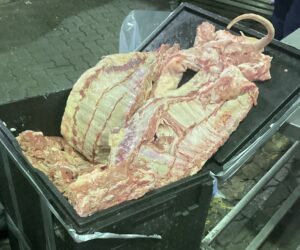
The warning was issued by Lucy Manzano, DPHA’s head of port health and public protection, in a hugely informative evidence session in front of the Environment, Food and Rural Affairs Committee, during which she laid bare the deep flaws in the UK’s border controls, including some heavy criticism of Defra.
This included the observation from Ms Manzano and Helen Buckingham, an Environmental Health Practitioner and regulatory consultant, that products from Germany continued to enter the UK after the foot-and-mouth disease (FMD) ban came into force.
Currently DPHA operates at around 20% coverage due to financial constraints, but has still managed to seize 170t of illegal meat since September 2022.
In contrast to Defra’s repeated claims that this work at Dover is led by Border Force, Ms Manzano stressed that DPHA was the lead body – out of around 71 tonnes of meat seized in a year, DPHA was responsible for nearly 69t, she said, adding that in the first two days of February alone, the DPHA team removed almost 4t of illegal meat.
Yet this work, carried out in incredibly difficult conditions in the passenger lanes at the port, may have to stop soon because funding has not been provided for the 2025/26 financial year, she said.

Responding to a question by former NPA senior policy adviser Charlie Dewhirst, now an MP sitting on the EFRA committee, Ms Manzano said DPHA, as requested, had submitted funding models to Defra for 100% coverage and one for £6m for 50% coverage, which also cover Coquelles, the Eurotunnel entry on the French side. But there had been ‘no substantive response’ from the department, she added.
“There are significant gaps in the controls that are taking place. Defra is not communicating regarding the intelligence or understanding what’s actually happening on the ground, which is fairly fundamental in this,” she said..
“If our funding is not secured within the next seven weeks, obviously coming into year-end, these checks will stop because the local authorities are not in a position to fund them.
“If we are not at the port, the seizures are not taking place and the vehicles will be put to one side until we are there to process them. That is the operational reality at the Port of Dover.
“If we’re not there, this stuff is going out on the shelves. This is not stuff where, traditionally, it would be hard to get hold of – this meat is appearing in shops on high streets and in markets. You may well be going out for dinner in normal looking establishments and be consuming meat that has not been correctly processed.”
She highlighted how organised criminals were targeting the UK with pork products from places like Romania where African swine fever (ASF) is rife and exports should be banned, suggesting the UK is seen as a soft touch because of its weak controls.
Also appearing in front of the committee, David Smith, Border Force’s, south east regional director, stressed that his organisation plays a big role alongside DPHA in tackling illegal meat imports but acknowledged that DPHA had the primary role in seizing illegal product.
He suggested that Border Force would also benefit from more funding, but insisted its work on illegal meat is a high priority, alongside drugs and weapons, for example.

Ms Manzano also highlighted the deep flaws in the government’s Border Target Operating Model (BTOM) that is allowing commercial meat imports to enter the country unchecked in large volumes.
These include the decision not to process checks at the point of entry at Bastion Point in Dover, a readily-available border control post, but to do so 22 miles inland at the new BCP at Sevington. This means vehicles that have been requested to present at Sevington for inspection can simply choose not to go or unload their vehicles first, while, in some cases, notifications are coming through too late.
She said very few checks were taking place at Sevington under the-risk-based system, with many consignments being auto-cleared under the ‘timed-out decision contingency feature’ (TODCOF) system.
This was introduced under the BTOM to help avoid delays at the new border control post at Sevington. It allows loads to auto-clear via a digital system two hours prior to arrival to avoid inspection, provided they have self-declared as being ‘low risk’.
But the flaws in the system mean criminal gangs are easily able to target the UK, Ms Manzano said.
“Defra has continually stated that there are robust controls in place. There are not. They don’t exist and they have overstated the activities of Border Force at the border to identify commercial goods,” she said.
She said DPHA had stressed to Defra and the Food Standards Agency that the system is ‘not working and we have to action change’.
Ms Manzano repeatedly highlighted the lack of communication and direct contact from Defra, for example in responding to the FMD outbreak, regarding what is happening at the front line.
She suggested this had been the case for a few years – for example, no ministers have visited Bastion Point in Dover to see at first hand the work there in seizing illegal meat imports.
At one point EFRA chair Alistair Carmichael suggested Defra wasn’t speaking to DPHA because ‘they might hear things they don’t want to’.
Ms Buckingham revealed she is often contacted by inland authorities, who are having to ‘pick up the debris’ being let through the UK’s various points of entry, but said Defra appeared to be unaware of this wider impact of the border failings.
“There are a lot of players in this space with a lot of distinct responsibilities in a very complicated landscape, but biosecurity threats that we’ve been hearing about do not respect geographical boundaries or legislative boundaries or the respective responsibilities of government departments,” she said.
“Therefore in this context, inter-agency working needs to be incredibly united and robust. My colleagues would say there is an extreme lack of understanding about the enforcement delivery on the front-line – the people that are writing the rules are not asking us to help them write it, to help them shape it and to make it workable and that’s where there’s been a real breakdown in communication between national level and what’s happening on the ground.
“They just don’t understand what’s happening. In my 30 years, I‘ve hardly ever known about Defra reaching out to positively communicate with local authorities inland.
“The inland local authorities are running around picking up all this debris up when it lands, either from the illegal personal route or from failed SPS checks.
“But their work isn’t being counted and they have no means of sharing intelligence with each other – and, that for me, is a real breakdown in this network. It could be so much better.”
The experts discussed with the MPs the huge risk to UK livestock posed disease like FMD and ASF getting into the country undetected. The human health implications were discussed, with meat that has often not been subject to any safety standards and may have been transported in unhygienic, unrefrigerated transport getting into the food chain.
Ms Buckingham also highlighted the risk of zoonotic diseases, which can pass from animals to humans, being allowed into the country.
Comments are closed.
The BBC considers this most serious situation to be newsworthy. HM Govt needs to be questioned hard to if it is a) concerned that a citizen may die from food poisoning, b) a farmed animal notifiable disease occurs.
https://www.bbc.co.uk/news/articles/cglydk3d7wko